
Every HR and office manager knows the feeling. You spend three weeks researching corporate gifts, approve the budget, manage the fulfillment logistics, and then watch a branded fleece get worn exactly once at the company holiday party — before disappearing forever. The gift was fine. It just wasn't memorable.
The corporate gift problem isn't budget. It's that most gifts optimize for "presentable" instead of "kept." A gift that earns permanent desk space requires something specific: it either solves a daily problem, creates an emotional anchor, or becomes a story someone tells. Generic branded items rarely do any of the three.
Here are seven corporate gift categories worth considering, with honest notes on what each actually delivers and who keeps them.
A High-Quality Desk Plant
A low-maintenance succulent or air plant with a quality ceramic pot is genuinely appreciated and gets placed on desks — where it stays, sometimes for years. The upside: personal, living, zero branding pressure. The downside: impersonal in the specific sense that it's not about the person or the team. It communicates "we care about your workspace" but not "we're glad you specifically work here." Works well as a seasonal gift or a thoughtful addition to a larger kit. Fails as a standalone recognition gift.
Quality Food and Drink
A curated snack box, a bottle of good wine, a coffee subscription, or a set of specialty teas. These get used and enjoyed — and enjoyed gifts create goodwill. A 25-person product team that received a curated artisan food box for the holiday season rated it the most popular company gift in a survey the following January. The limitation: food gifts are consumed and gone. They create a moment of goodwill but no lasting artifact. Also, dietary restrictions and preferences mean something that delights half the team disappoints the other half.
Notebooks and Writing Supplies
Quality notebooks (Leuchtturm1917, Moleskine, Field Notes) genuinely appeal to a segment of knowledge workers who use them every day. The challenge: this segment is shrinking. Most people who would use a quality notebook already have one they chose for themselves, and most people who don't use notebooks won't start because they received one. Notebooks score high on "respectable gift" and medium on "gift that actually gets used."
Experience Vouchers
Restaurant gift cards, spa vouchers, experience bookings (cooking class, wine tasting, axe throwing). These are popular precisely because they solve the personalization problem by deferring the choice to the recipient. But they're also anonymous — the gift that says "spend this money on something you'll enjoy" is appreciated and immediately forgotten. Experience vouchers are a good choice for teams where preferences are genuinely unknown. They're a less good choice when you want the gift to reflect something specific about the relationship.
Good Headphones or Audio Equipment
For knowledge workers who spend hours in meetings or work in open-plan environments, quality wireless headphones are among the highest-utility corporate gifts. They earn desk space because they get used daily. The catch: they're expensive at the quality threshold where they feel like a real gift ($150–$300 for wireless noise-canceling), which means they work better as recognition gifts for individual employees than as company-wide gifts. And they signal utility rather than warmth — useful, but cold.
Personalized Items (Done Right)
Personalization is one of the highest-value levers in corporate gifting — and also one of the most frequently misused. "Personalized" often means "your name laser-engraved on a water bottle." That's monogramming, not personalization. Real personalization means the gift is specifically about the person and their context — what they care about, who they work with, moments they were part of.
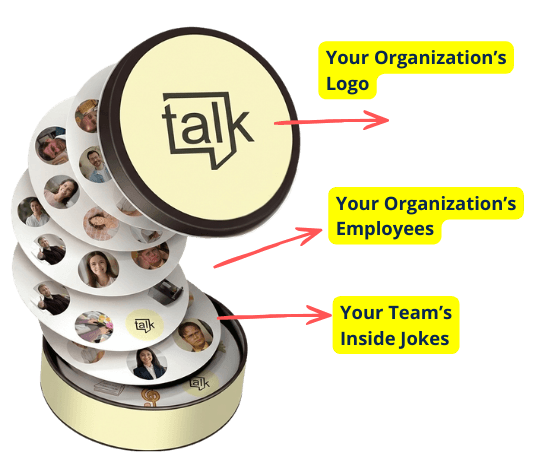
A gift where the content is the team itself is a different category. An item that features the actual people in the room — the faces, the team, the shared context — is personal in a way that an engraved water bottle isn't. It's not a substitute for the person's name; it's a mirror of the community they're part of.
This is the thinking behind a custom team matching game. The gift is literally made from your team's photos. Every disc shows a face from the group. The game is something people play together, and then individual discs end up on desks because they feature real colleagues, not abstract brand assets. It's the format where "personalized" actually means something. See how it works as a corporate gift here. Or see the full custom corporate gifts page and the client appreciation gifts page for related context.
Something That Becomes a Story
The highest-performing corporate gifts share one trait: they generate a story. "Remember when the company sent us all a board game made from our LinkedIn photos and we played it at the offsite" is a story. "The company gave us good headphones last year" is not.
Story-generating gifts tend to be unusual, specific, and connected to the team's shared context. They don't need to be expensive. They need to be memorable in a particular way — connected to something the group experienced together or to the people in the room.
The ROI Question
Before approving any corporate gift budget, it's worth asking: where does this gift live in six months? A quality desk plant might live on someone's desk. Headphones will definitely be on someone's desk or in their bag. A branded fleece is probably in a drawer. A game made from your team's photos is either on a shelf where someone can grab it or on a desk where the discs are on display.
Gifts that stay visible earn long-term ROI. The best ones don't just sit there — they get used again, shown to other people, and referenced in conversations. That's the threshold worth targeting.
Frequently Asked Questions
What's the most common mistake in corporate gifting?
Optimizing for "looks good in a photo" over "gets used and remembered." Curated kits with five items often photograph beautifully and get unpacked once. The gifts with the highest real-world impact tend to be single, quality items that solve a real daily problem or create a genuine emotional moment.
How do you make a corporate gift feel personal without knowing each person's preferences?
Make it about the team rather than the individual. A gift that features the group — your team's shared photos, a game that requires the group to play together — is personal without requiring individual preference data. It's the format that works at scale.
What's the right budget for a corporate gift?
For company-wide gifts: $50–$100 per person is the practical range. Under $25 risks feeling token. Over $150 at company scale is hard to justify unless it's a specific recognition moment. For recognition gifts to individual high performers or long-tenure employees, $150–$400 is appropriate.
Should the gift be branded with the company logo?
For items that go on desks or into bags, light branding is fine. For items that people use in public (clothing, bags), branding reduces how often the item actually gets used. The rule of thumb: the more an item is "used by the person in front of others," the less aggressive the branding should be. Items used privately can carry heavier branding without reducing usage.
What's a good gift for a distributed or remote team?
Something shippable that creates a synchronous moment. A game everyone can play together at the next all-hands. A kit that arrives before a virtual event and gets opened live on camera. The goal for remote teams is to engineer the shared moment that physical proximity would create automatically.