
You've been tasked with running an icebreaker. Maybe it's a new-hire orientation, a company offsite, or a department that's been working together for months but still feels oddly formal in meetings. You need something that works on 30 people, doesn't require anyone to act embarrassed, and doesn't take 45 minutes to explain.
Most icebreaker lists on the internet recycle the same five activities. Some of them work fine. Some of them quietly die in a conference room while people check their phones under the table. Here are eight that actually earn their place in the agenda — with honest notes on where each one lands.
1. Two Truths and a Lie
The classic is classic because it works. Each person shares three statements about themselves — two true, one false — and the group guesses which is the lie. It requires no materials, no setup, and reveals genuinely interesting things about people.
Where it falls short: it requires everyone to be comfortable speaking in front of a group, and the quality of the activity depends entirely on how creative people are willing to be. Shy teams produce safe, boring truths. It also scales poorly — 30 people doing two truths in sequence takes an hour.
Best for: small groups of 8–15, teams where people are already somewhat comfortable with each other.
2. Human Bingo
Create a 5x5 bingo card where each square has a trait or experience ("Has lived in three countries," "Can juggle," "Has run a marathon"). People circulate and find a colleague who matches each square. First to complete a row wins.
It gets people physically moving, which breaks the conference-room energy fast. The activity creates genuine one-on-one moments — you're not performing for the group, you're just talking to one person at a time. Works well for groups of 20–80. Preparation takes about 20 minutes to design the card.
Best for: large onboarding events, all-hands gatherings, company-wide offsite openings.
3. Photo Scavenger Hunt
Teams of 3–5 people are given a list of photos to take within a set time window — often around an office or event venue. "A photo of your team with something yellow," "A photo where everyone is looking in a different direction," "A photo that tells a story about your team." Teams submit their best shots and the group votes on favorites.
This one works because it creates a shared mission and a deliverable. The conversation happens during the hunt, not in front of an audience. A 40-person engineering team at a SaaS company we know uses this at every quarterly offsite — it runs itself once the list is distributed, and the debrief (viewing the submissions) generates real laughter. The downside: you need a space where wandering is possible, and the coordination of submissions takes a tool (Slack, email, or a dedicated app).
Best for: medium to large groups at venues with some physical space.
4. The Question Ball
Inflate a beach ball and write open-ended questions on each panel ("What's something you're learning right now?", "What's the best meal you've ever had?"). Toss it around the group — whoever catches it answers the question under their right thumb. Simple, low-pressure, no winning or losing.
Works better than a random question prompt because the physicality of the ball creates momentum and breaks the stiffness of sitting in chairs. It keeps energy moving. Best for small to medium groups under 25, and works especially well at the start of a workshop when you want the room to loosen up before real work begins.
5. Speed Networking (Timed Pairs)
Arrange chairs in two facing rows or concentric circles. Pair people across from each other, give them 90 seconds to answer one question ("What's one project you're most proud of from the last year?"), then rotate. Run for 6–8 rounds.
This is the icebreaker that scales. It works for 20 people or 200. Everyone talks, nobody waits, and the structured time limit removes the social anxiety of not knowing when to end a conversation. The format is borrowed from speed dating, which makes some people roll their eyes — until they're in it and realizing they just had eight actual conversations in 12 minutes.
Best for: large groups, cross-departmental mixers, conference networking sessions.
6. Office Trivia With Personal Submissions
Ask everyone to submit one unusual fact about themselves before the event. Build a short trivia game around those submissions — "Who on the team has this unusual skill?" or "Whose photo is this from 10 years ago?" Teams compete to match the fact to the person.
Unlike generic trivia, this version creates investment. When your own fact is the question, you're paying attention. It rewards people who actually know their colleagues and exposes things about teammates that would never come up in a normal meeting.
Preparation time is moderate — someone needs to gather the submissions and build the game. Tools like Kahoot or Mentimeter make it easier to run in real time.
7. A Personalized Matching Card Game
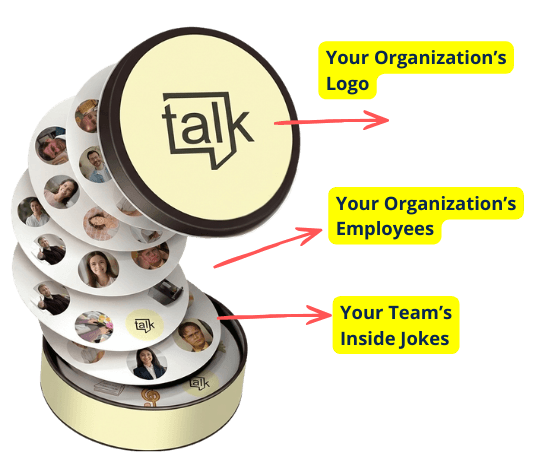
A custom matching game built from your team's photos — like the one PairPops makes — sidesteps almost every common icebreaker failure mode. There's no public speaking. No one has to perform. The game explains itself in 10 seconds: flip two discs, find the shared face, call it out. The photos on the discs are your actual teammates, so the game's content is already personal.
For a 45-person customer success team joining an all-hands event, this format lands particularly well because it works simultaneously across multiple groups. Five tables of nine people can all be playing at once — no facilitator required, no waiting for turns. People end the game knowing more faces and names than they did 20 minutes earlier. And because the discs are physical and branded, they end up on people's desks afterward.
It's one of the few icebreakers that works as both an activity and a keepsake. If that angle fits your event, see how the custom corporate version works.
8. Silent Line-Up
Ask everyone to line up in order of some attribute — without speaking. Birth month, years at the company, distance traveled to get here. The group has to coordinate through gestures, eye contact, and creative non-verbal communication. Then, once the line is formed, people introduce themselves to the person next to them.
This one is genuinely fun precisely because it's slightly absurd. It works best with groups that might otherwise be awkward with each other — and the brief moment of chaos before the line forms usually produces the first real laughs of the day.
Choosing the Right One for Your Group
The right icebreaker depends on three things: group size, energy level, and how much setup time you have. Small groups with a facilitator can use conversation-based formats. Large groups without a dedicated facilitator need activities that run themselves — structured rotations, physical games, or team games with clear rules.
For corporate events, the most common mistake is choosing an activity that requires public performance from introverts or that drags across a 30-person group for 40 minutes. The best icebreakers create many small conversations simultaneously, not one large performance.
Frequently Asked Questions
How long should a team building icebreaker take?
For a standard meeting or workshop opener: 10–15 minutes. For a dedicated icebreaker session at an offsite or all-hands: 20–30 minutes. Longer than that and it stops being an icebreaker and starts being the main event — which changes what you should choose.
What's the best icebreaker for a large group (50+)?
Activities that split into parallel smaller groups work best at scale: human bingo, speed networking rotations, or table-based games that run simultaneously. Anything requiring the whole group to go one at a time stops working above about 20 people.
What if my team already knows each other?
The goal changes from "learn names" to "deepen connection." Activities that reveal surprising personal facts (photo trivia, unusual personal questions) tend to work better than logistical icebreakers (human bingo, lineup games) for established teams.
Do icebreakers actually work, or do people hate them?
It depends entirely on the format. Forced sharing in front of large groups tends to generate eye-rolls. Activities that feel like play — games, challenges, physical movement — tend to work because people forget they're doing an icebreaker. The bar is: does the activity create actual conversation, or just the illusion of one?
Can an icebreaker work for a remote team?
Yes, but format selection matters more. Trivia games on Kahoot, virtual escape rooms, and Jackbox-style games all transfer to video calls. Physical games obviously don't. The full roundup of team building games covers remote-compatible options separately.