
You're planning a corporate event — an offsite, a team day, an all-hands evening — and you need to choose an activity. The pressure is obvious: whatever you pick, it has to work for 40 people who have different interests, different energy levels, different relationships with "fun at work," and varying degrees of enthusiasm for being at a corporate event at all.
Most activity-planning conversations start with a list ("What about axe throwing? What about an escape room?") and end with a vote or a manager's preference. The problem with that approach is that it's about what sounds appealing to whoever is in the room — not about what will actually work for the group.
This guide offers a different starting point: a set of concrete criteria that predict whether an activity will work across a typical corporate group, and an honest evaluation of common formats against those criteria.
The Five Criteria That Actually Predict Whether an Activity Works
1. Does it work for all personality types?
The most common failure mode in corporate activities is optimizing for extroverts. Improv comedy workshops, karaoke, and activities that require public performance are loved by a subset of any group and quietly dreaded by another. An activity that requires people to perform in front of peers creates involuntary vulnerability — and the team members who most need to feel comfortable often feel least comfortable in those formats.
Activities that work across personality types share a common trait: participation is driven by the game's rules, not by personal charisma or willingness to perform. You don't need to be funny. You don't need to be outgoing. You just need to play.
2. Is there an explanation barrier?
The amount of time required to explain an activity is inversely correlated with how much people enjoy it. Every minute of explanation is a minute of low energy, and a long explanation signals complexity — which signals "this might be frustrating" before anyone has played.
The best activities explain themselves in 30 seconds or demonstrate in a single round. Anyone at the table can explain the rules to a newcomer after watching one game. This is a feature, not an accident of design — it's what makes a format accessible to people who weren't paying attention during the introduction.
3. Does it require physical fitness or physical ability?
Any activity that requires running, jumping, physical competition, or a specific physical skill excludes or disadvantages a portion of every corporate group. Axe throwing requires upper body strength. Bowling disadvantages people with wrist or back issues. Obstacle courses are obviously out. Activities that involve physical movement as a feature — rather than a requirement — are worth including; activities where physical performance determines success are worth avoiding at company scale.
4. Does it work across ages, roles, and departments?
A corporate event brings together a product manager who's been at the company eight years, a new sales hire who started last month, a VP who has back-to-back calls until 6pm, and an office manager who organized the whole thing. The activity you choose has to create a level playing field that doesn't advantage any particular tenure, role, or department.
Activities that reward company knowledge disadvantage new hires. Activities that reward seniority feel exclusionary to junior team members. The best formats create a context where none of that prior context matters — where the new hire has the same shot at winning as the long-tenure executive.
5. Does it leave people with something?
This is a less obvious criterion but a meaningful one. Activities that leave participants with a shared memory, a physical object, or a story tend to have longer-lasting impact on team cohesion than activities that simply fill the time slot. The question is: three weeks from now, will anyone reference this? If the activity created a moment people talk about, it did its job. If it was "fine," it was also forgettable.
How Common Activities Score on These Criteria
Cooking class
Works for most personality types (it's task-oriented, not performance-oriented). Has a moderate explanation requirement for technique. Excludes people with physical limitations (standing for 2+ hours, knife work). Creates a shared outcome (the food you made). Scores: good on personality types, weak on physical accessibility, strong on shared outcome.
Escape room
Excellent for personality types — introverts often excel at puzzle-solving. Low explanation barrier once you're inside. Limited physical requirements. Works across ages. The limitation: scales poorly. Most rooms accommodate 4–10 people, which means 40 people need four simultaneous rooms and coordination becomes complex. Scores well on most criteria; fails on scale.
Trivia night
Works across personality types when done in team format (nobody has to speak alone). Explanation is minimal. No physical requirements. The big variable: question categories. A trivia night heavy on sports or pop culture references from the 1980s disadvantages international employees and younger team members. Custom company trivia solves this but requires prep. Moderate scores overall; highly variable based on question design.
Axe throwing
Appeals to a specific demographic and alienates others. Requires upper body strength and coordination. Has an explanation/safety briefing that takes 15+ minutes. Generates some excitement and story. Scores poorly on personality types and physical accessibility; moderate on shared memory.
Personalized matching card game
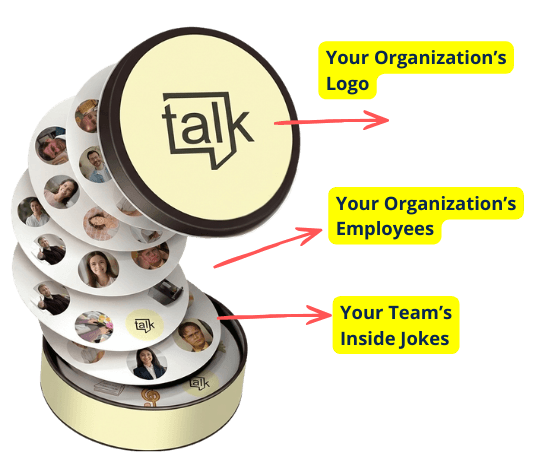
This format — where the photos on the game are your actual team members — scores unusually well across all five criteria. It requires no physical ability beyond holding two cards. The explanation takes 10 seconds. It works for 6 or 60 players simultaneously in parallel groups. It advantages no particular department or tenure. And because the content is the team itself, the activity naturally creates conversations about the people in the room — which is the actual goal of most corporate team events.
The additional criterion it hits that most activities miss: people take the discs home. The game leaves a physical artifact — a disc with a colleague's face on it — that lives on desks and travels in bags. That's the "leaves something behind" criterion satisfied in a way that most activities don't touch.
For corporate events specifically, a custom corporate card game from PairPops is worth looking at. The full format — how to order, what customization looks like, and what timeline to expect — is at the custom corporate card game page. For conference and large-event contexts, see the conference icebreaker game page and corporate event games page.
The Decision Shortcut
If you're on a deadline and need a quick filter: reject any activity where you can immediately think of three people in the company it won't work for. If you picture the 60-year-old VP, the new hire who started last week, and the developer who never attends social events — and all three can participate fully — you're probably in the right territory.
The best corporate activities create participation through design, not through social pressure. They don't require you to be the most outgoing person in the room. They don't reward existing relationships or tenure. They give everyone the same shot at the game — and let the game do the work of creating connection.
Frequently Asked Questions
How do you handle a group with wildly different interests?
Choose a format where the activity's content is the group itself, not an external topic. Trivia about pop culture divides on pop culture preference. A matching game featuring photos of your actual team doesn't — everyone is invested because the content is people they know.
What's the ideal group size for a corporate activity?
Between 15 and 60 is the most common range, and the activity format needs to accommodate it. Activities that require the full group to participate simultaneously scale poorly above 20. Activities that run in parallel groups of 6–10 scale well to any size. When planning for 40+ people, default to parallel formats.
How do you balance a fun activity with budget constraints?
The relationship between budget and enjoyment is weaker than most planners expect. Expensive activities (renting a cooking studio, booking a professional improv troupe) often land flat. Lower-cost formats with strong design — games, structured challenges, well-run trivia — often perform better. A $30-per-person activity with great design beats a $150-per-person activity with poor fit for the group.
Should the activity be competitive?
Light competition creates energy. High-stakes competition creates winners and losers — and losers who feel like they underperformed in front of colleagues. The sweet spot: activities with a clear winner but where the "losing" experience is still fun and collaborative. Team-vs-team formats often work better than individual competitions in corporate settings.
What if the group is mixed — some employees, some clients or partners?
Avoid activities that reward internal knowledge or create in-group/out-group dynamics. Formats that work on any group composition (trivia about a neutral topic, physical challenges, card games) are safer than formats that depend on shared context. A matching game built from the combined photos of both groups — employees and clients — is an unusual but effective option for mixed corporate events.