
At some point, every growing company makes the same welcome kit. Branded hoodie. Branded water bottle. Branded notebook with a pen clipped to the cover. Maybe a pair of socks. Sticker pack. Handwritten note from HR that's clearly a template.
The kit communicates: "You work here now." What it doesn't communicate is: "We thought about you specifically." And for a new hire showing up on their first day — often anxious, often not knowing a single face in the room — that difference is larger than it looks.
Here are nine welcome kit ideas worth actually considering, with honest notes on what each one does well and where it falls short.
1. A Good Pair of Wireless Headphones
Practical, universally useful, and genuinely appreciated. A new hire at a company where the office is open-plan will use these every single day. They don't carry the brand — but they carry goodwill. The downside: expensive at $150–$300 for quality, and the gift reads as utility rather than warmth. Great for companies that want to signal investment in the employee's actual work environment.
2. A Local Restaurant or Food Delivery Gift Card
A $50–$75 gift card to a local delivery app, a neighborhood restaurant, or a coffee shop near the office. Covers the "I don't know where to eat lunch near the office yet" problem that every new hire has for the first two weeks. No branding, pure utility, low cost, high appreciation rate. The limitation: it's transactional. It solves a logistics problem but doesn't build connection.
3. An Ergonomic Desk Accessory
Laptop stand, monitor riser, or a quality mouse pad. These are the things new hires appreciate but rarely buy for themselves. They last years and get used daily, which means the company's investment stays visible on the desk well past onboarding. Impersonal but practical. Works best when paired with something warmer.
4. A Handwritten Note From Their Actual Manager
Not from HR. Not a template. A note written specifically by the person who interviewed them — referencing why the company is excited to have them specifically, one thing they're looking forward to working on together. This costs nothing except five minutes of the manager's time. Its impact-to-cost ratio is higher than anything else on this list. The catch: it requires managers to actually write them, which means it either becomes a policy that gets enforced or quietly dies.
5. A Book Relevant to Their Role
Not a generic business book. A book someone on the team actually recommends — ideally one with a short note about why. A new marketing hire might receive the book the CMO references in every strategy meeting. A new engineer might receive the book their tech lead uses to explain system design. This works because it signals "we know what you're here to do and we want to help you do it well." It also gives the new hire a conversation starter with their team.
6. A Team Photo or Culture Book
A small printed book — or even a single laminated page — with photos of the team, names, roles, and one personal fact per person. Something the new hire can flip through before their first meeting. Low production cost, high usefulness for the specific job of "learning who is who." The challenge: it goes stale quickly at fast-growing companies, which means someone has to maintain it.
7. Something That Helps Them Meet the Team Before They Meet the Team
This is the category that most welcome kits skip entirely. Branded swag communicates the company. It doesn't communicate the people. A new hire who can put faces to names before their first day feels meaningfully less like a stranger — and the research on onboarding shows that early social connection is one of the strongest predictors of new hire retention.
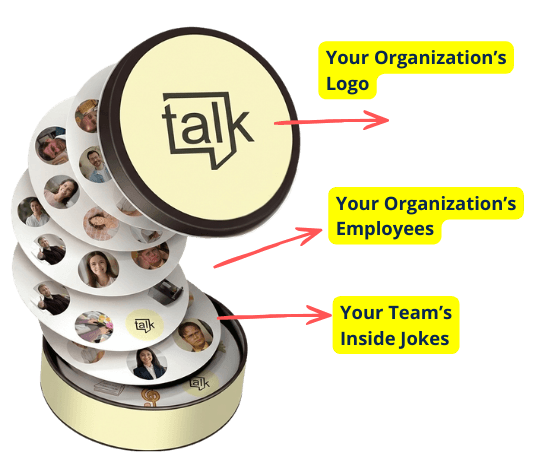
One format that does this job well: a personalized matching game made from your team's actual photos. Each disc features a teammate's face. The game — a simple matching mechanic where you race to find the shared face between two discs — runs in minutes and encodes the names and faces in a way that sticks. It's not trivia. It's pattern recognition, and it's surprisingly effective at making 30 strangers feel like faces you've seen before.
This is exactly what PairPops makes for onboarding. The game goes in the welcome box alongside the hoodie. A new hire who opens it on their first night has already played a round before they've walked in the door. You can see the full onboarding use case at the employee onboarding game page and the new hire welcome game page.
8. Day-One Survival Kit
Small, practical items for navigating the first day: a physical map of the office (if multi-floor), an ID card holder, the Wi-Fi password in a format they can save, a printed list of "first week must-dos," and one coffee shop recommendation from someone on the team. None of this is branded. All of it is useful in the first 24 hours. Works best at larger companies where the first day involves a lot of navigation.
9. An Experience Instead of a Thing
Budget for a team lunch on the new hire's first Friday. A $200 card to cover "first team dinner on us." A standing invitation to a 30-minute coffee chat with someone in a different department. The experience doesn't live in a box — but it creates the kind of memory that a hoodie never will. The challenge is coordination: it requires someone to actually schedule and follow through.
The One Question to Ask Before You Finalize Your Kit
What specific problem does this kit solve for a new hire in their first two weeks? If the answer is "it makes them feel welcome," that's vague enough to mean anything — including a pile of branded items that adds up to nothing emotionally. The kits that work are the ones built around the real friction points: not knowing who people are, not knowing where to eat, not knowing what to do on day one, and not feeling like the company was expecting them.
If you're building or refreshing your welcome kit, adding a personalized team game to the box is a practical answer to the "how do they learn the team?" problem — one that existing kit items don't address at all.
Frequently Asked Questions
How much should a new hire welcome kit cost?
Depends on role seniority and company size. For early-career roles, $75–$150 is typical. For senior hires, $150–$300. The quality of a few things matters more than the quantity of many things. A $200 kit of five thoughtful items lands better than a $200 kit of twelve generic ones.
What's the single highest-ROI item in a welcome kit?
The handwritten note from the direct manager, if it's genuinely personal. It costs nothing and has a higher emotional impact than anything purchased. After that: anything that helps the new hire feel like they belong on the team specifically, not just "at a company."
Should the welcome kit arrive before the first day or on the first day?
Before, if possible — especially for remote hires. Receiving the kit a few days before the start date gives a new hire time to explore it, process the nerves privately, and feel more prepared walking in. Delivery on day one means it competes with the chaos of getting set up.
What's one thing most welcome kits are missing?
Anything that helps the new hire put faces to names. Branded swag communicates the company's identity but not the team's. A team photo, a photo book, or a personalized game that features real teammates addresses a gap that standard welcome kits consistently ignore.
Can a welcome kit work for remote new hires?
Yes — it's arguably more important for remote hires, who don't have the organic hallway moments that help in-office employees learn the team passively. Ship it to their home address. For remote teams specifically, anything that replicates in-person connection (team photos, video intro links, a game they can play at a virtual all-hands) is worth the extra thought.