
Not every company has an HR team large enough to staff a dedicated facilitator for every team event. Not every team lead has the time — or the inclination — to stand at the front of the room and guide 30 people through a structured activity. And professional facilitators, when they're good, run $1,500–$5,000 for a half-day session.
The good news: the best team activities don't actually need one. The ones that work without a facilitator share a common trait: the rules and the energy are built into the format itself. The activity starts the moment someone opens the instructions. Nobody has to explain it for 10 minutes before it begins.
Why Most Activities Require a Facilitator (And Why That's a Design Failure)
Most team building activities are designed with a facilitator in mind because the facilitator manages ambiguity. When the instructions are vague, someone needs to interpret them. When the group gets stuck, someone needs to prompt. When the debrief question runs dry, someone needs to redirect.
Activities that require this kind of scaffolding aren't actually self-contained. The format has outsourced its structure to a person instead of building it in. That's a reasonable design choice when you have a facilitator — and a liability when you don't.
Self-running activities solve this by having exactly one way to begin, a clear endpoint, and no ambiguous moments in between. The group never has to wonder what to do next.
Self-Guided Trivia
Platforms like Kahoot, Mentimeter, and Quizalize let you build a trivia game that runs entirely on participants' phones. One person shares their screen and presses "start." The game calls the questions, collects answers, tracks scores, and announces a winner. There's no human host required.
The catch: someone has to build the quiz beforehand. For team-specific versions (trivia about your company history, your colleagues' unusual hobbies), this takes 45–90 minutes of prep. The payoff is an activity that runs for 20 minutes without a single person having to manage the room. A 60-person marketing team at a B2B software company used a custom Kahoot about their own company's founding story at a company anniversary event — the quiz ran itself while the People team ate dinner.
Escape Room (Physical or Digital)
Commercial escape rooms are self-running by design: the room has puzzles, the clock runs itself, and the only job of the escape room staff is to check you in and let you out. For 6–12 people who can book the same room, there's no facilitation needed.
Virtual escape rooms (Enchambered, The Escape Game, Teambuilding.com) follow the same design and work for remote teams. The trade-off: most escape rooms accommodate groups of 4–10 per room, so larger teams need multiple bookings or a format that scales differently.
Card Games and Board Games With Clear Rules
Games with rulebooks are inherently self-facilitating. The rules explain the game; the game runs the activity. This works especially well when the game itself is connected to the team — so the content carries meaning beyond just "we played a game together."
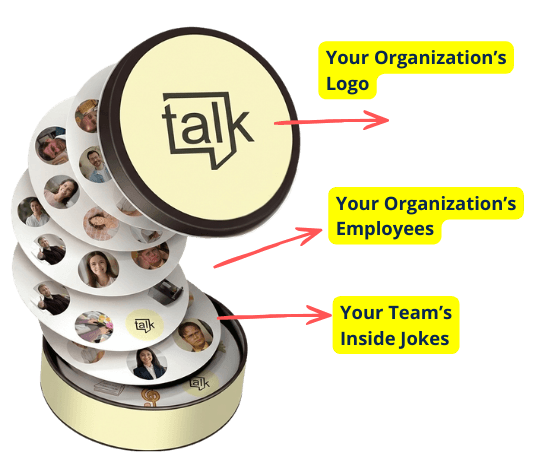
A personalized matching card game — where the photos on the cards are your actual team members — is the format that most naturally combines "clear rules" with "personal content." The game takes 10 seconds to explain: flip two cards over, find the shared face, call it out first. No whiteboard needed. No debrief required. The game does the work of getting people to learn each other's names and faces without anyone having to organize it. This is exactly what PairPops is built for — a custom card game with your team's photos that runs itself from the moment the tin is opened.
For a 25-person onboarding cohort at a mid-size tech company, this format works because you can split into groups of 6–8 at separate tables, all playing simultaneously, with no one person responsible for running the room. The activity runs in parallel, not in sequence.
Async Challenges (For Remote or Distributed Teams)
Async challenges work on a different model: instead of everyone doing the same thing at the same time, participants complete a challenge on their own schedule within a window (usually 24–72 hours). Examples include photo challenges ("share a photo of your workspace that tells us something about how you work"), recipe shares, or short video introductions.
These require almost no facilitation — you set the prompt, share it in Slack or email, and collect submissions. The debrief (viewing what people submitted) usually happens at the start of the next team meeting and takes 10 minutes. The limitation: async formats don't create the same synchronous energy as live activities. They work well as a complement to, not a replacement for, in-person connection moments.
Structured Conversation Cards
Products like Bright Moments, TableTopics, or We're Not Really Strangers give groups a deck of cards with questions designed to create meaningful conversation. The format self-runs: draw a card, answer the question, pass to the next person. No facilitator. No prep. The cards carry enough structure that people know exactly what to do.
For small teams of 4–8 people at a team dinner or an informal team check-in, this format works well. It doesn't scale above 10–12 without breaking into multiple groups. It also requires participants willing to be genuine — it fails with groups that are too guarded to answer honestly.
The Test: Can Your New Hire Run It?
A useful heuristic: could your newest, least-contexted team member run this activity if you handed them the box and walked away? If the answer is no — if it requires someone with institutional knowledge, presence, or confidence to manage — you don't have a self-running activity. You have an activity with a hidden dependency on a facilitator you haven't hired yet.
The activities above pass this test. The instructions are the facilitator. The format is the structure. You show up, open the box (or click start), and the activity begins.
If you're looking for the option that requires the least coordination while still creating genuine connection, a personalized team card game is worth a look — it works for groups of 6 or 60 and requires nothing beyond someone opening the tin. You can see how the ordering process works and how it fits onboarding specifically.
Frequently Asked Questions
What's the minimum prep for a facilitator-free team activity?
Depends on the format. Card games and board games require zero prep — you buy or order them, bring them to the event, and open the box. Trivia games require 45–90 minutes to build the quiz. Photo challenges require writing a prompt. The zero-prep options are almost always physical games with printed rules.
Can facilitator-free activities work for large groups?
Yes, if the activity is designed to run in parallel groups. A trivia game on Kahoot works for 200 people. A card game at tables of 8 scales to any room size. What doesn't scale: activities that require a single group to go one at a time (one person speaks while 29 wait).
What about the debrief — don't you need a facilitator for that?
Not always. Some activities are designed to generate their own connection without a structured debrief — the conversation that happens during the activity is the point, not a post-activity reflection. If your goal is connection rather than learning, skip the debrief. If your goal includes a lesson or team reflection, a simple written prompt ("what's one thing you learned about a colleague today?") passed in Slack can replace a live debrief.
Is a personalized card game worth the cost without a facilitator?
The math works differently than hiring a facilitator. A facilitator costs $1,500–$5,000 for a session. A custom card game for 30 people is a fraction of that, ships in 5–7 business days, and can be used again. For recurring events like quarterly all-hands or ongoing onboarding cohorts, the game outlasts the session. You can read more at the office icebreaker game page.
What's the biggest mistake companies make with facilitator-free activities?
Choosing an activity that only appears to be self-running. Anything that requires "someone to get it started," explain a nuance, or manage group energy mid-activity is not actually self-running — it's a facilitated activity in disguise. The test is: if nobody said a word after pressing start, would the activity still work?