
A work scavenger hunt is often sold as an easy way to make employees laugh, move around, and break the ice. That advice misses the business question HR leaders need to answer: what changed because the activity happened? A hunt built around random trivia may create noise for an afternoon, but it rarely improves onboarding, cross-functional connection, or understanding of company culture.
The stronger approach treats the format as an experiential learning intervention. The academic discussion goes back at least to the publication of The Scavenger Hunt Exercise: Symbols of Organizational Culture in February 1996, which examined the activity as a way to observe and shape workplace culture, as documented in this history of team-building scavenger hunts. The difference between a forgettable event and a useful one is design discipline. You need a business objective, clues connected to real organizational life, inclusive team mechanics, and a follow-up process that tests whether participants retained anything meaningful.
Why Most Work Scavenger Hunts Fall Flat
The most popular advice is usually the least useful: "Keep it fun." Fun matters, but it isn't a business objective. If the hunt doesn't help people learn a system, meet colleagues outside their usual circle, or interpret the company's values through real examples, the event may be enjoyable without producing lasting value.
Generic trivia creates the same problem. Questions about local landmarks, obscure facts, or workplace inside jokes can fill time, yet they don't necessarily help employees understand how the organization works. Participants may remember who won, but they won't remember a new workflow, a key colleague, or the cultural behavior leadership wants to reinforce.
Entertainment isn't the same as learning
A field-based organizational culture study found that scavenger hunts work best when clues connect to an organization's actual processes, artifacts, or symbols. Participants then need to interpret culture together instead of only retrieving information. The team-building exercise paper also emphasizes the structured debrief, because discussion after the activity turns movement and competition into learning.
Practical rule: If a clue could be copied into another company's hunt without changing a word, it probably isn't doing enough cultural work.
A second failure comes from designing the activity around the fastest individual. One confident employee solves every clue, chooses the route, and reports the answer while everyone else follows. The team technically completes the challenge, but the organization gets little shared problem-solving and limited relationship-building.
Design for a workplace outcome
A useful hunt starts with a question such as:
- Can new hires identify the systems and people they need during their first weeks?
- Can employees discover how another department contributes to the customer experience?
- Can a company value become visible through actual decisions, behaviors, and stories?
- Can distributed colleagues form relationships that continue after the event?
The historical shift from organizational culture exercise to onboarding, employee engagement, and corporate event format makes the activity more adaptable, not less strategic. Treat the work scavenger hunt as a short, observable learning experience. The clues create the conditions, the teams create the interaction, and the debrief gives the organization a chance to connect those experiences to work.
Defining Objectives and Success Metrics Before You Start
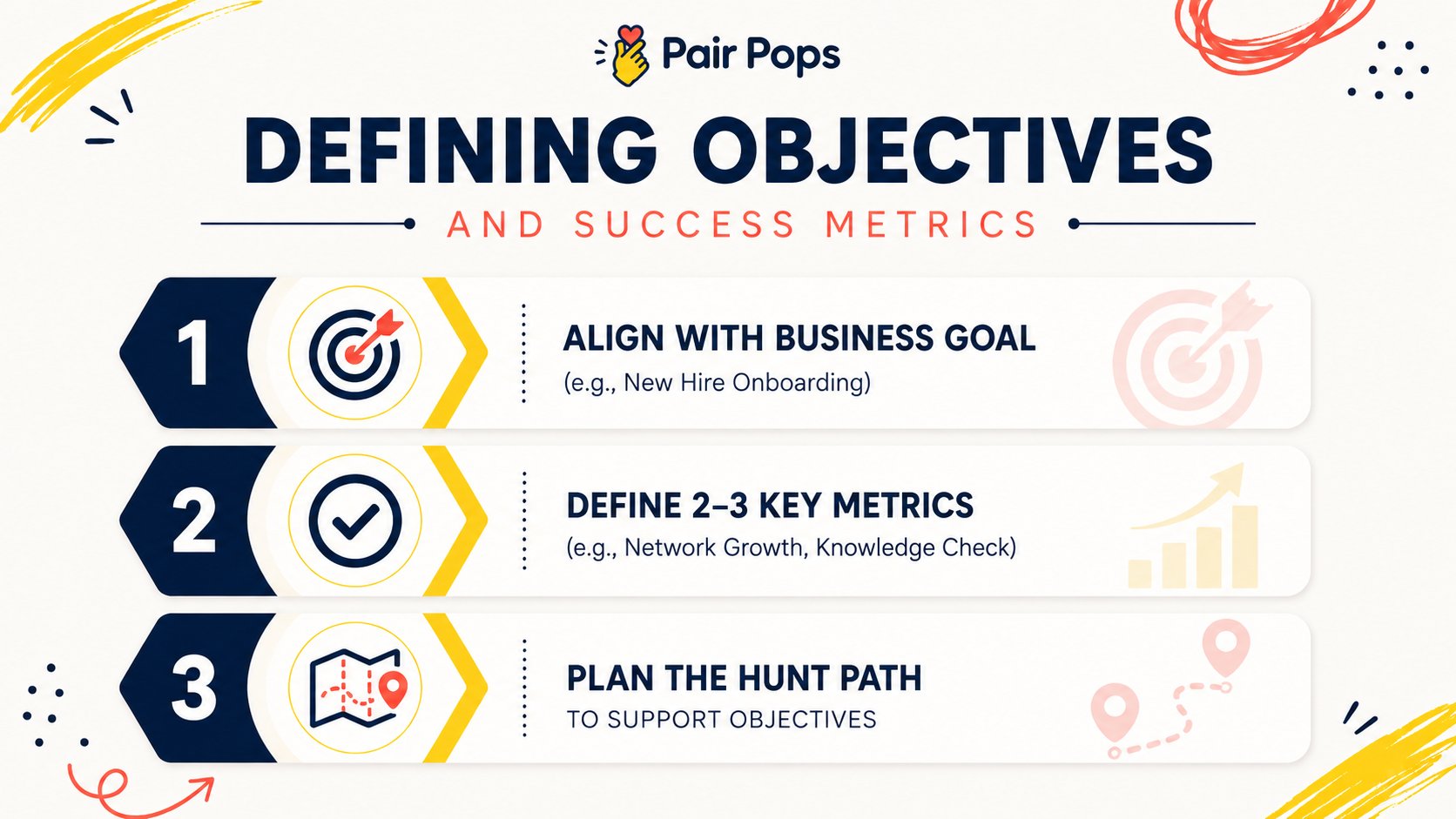
A work scavenger hunt can generate activity without producing business value. Set the outcome first, then design clues that let participants demonstrate it.
For onboarding, new employees might need to locate a policy, identify the owner of a critical process, and choose the internal tool for a common task. For cross-functional connection, participants could describe another team's work, name a useful contact, and explain how that work affects a shared customer or business priority. For culture, define an observable behavior, such as recognizing how a stated value influenced a real decision. These objectives give the event a purpose that can be assessed after the final clue.
Choose a small measurement set
Choose measures that connect directly to the objective. Participation rates, completion percentages, and post-event survey scores can show whether people joined, finished, and valued the experience, but they should not stand in for learning or relationship outcomes.
| Business objective | Immediate measure | Follow-up check |
|---|---|---|
| New-hire onboarding | Knowledge check on systems, processes, and contacts | Retention of key onboarding information |
| Cross-functional connection | Number and quality of new professional connections reported | Whether those connections remain useful later |
| Culture reinforcement | Ability to connect clues with stated behaviors | Examples of observed behavior or shared language |
| Employee experience | Participation and satisfaction feedback | Qualitative comments about belonging and collaboration |
Set a baseline before launch. A short pre-event pulse can ask how confident participants feel about the relevant systems, relationships, or cultural expectations. Repeat those questions afterward and ask what discovery was most useful. The comparison will not prove causation, but it gives leadership more context than attendance alone.
Make the route serve the measurement plan
Each clue should produce an observation, answer, interaction, or artifact tied to the objective. An onboarding hunt might require participants to locate a real resource or speak with its owner. A connection-focused hunt should create conversations with selected functions, rather than asking teams to photograph office objects.
Use this guide to choosing a corporate event activity to compare formats, then select the one that matches the result you need. A hunt suits goals built around exploration, conversation, and interpretation. It fits less well when the goal is to deliver information. After the event, review the measures with the planning team and record what should change before running the format again.
Designing Clues That Connect to Your Company Culture
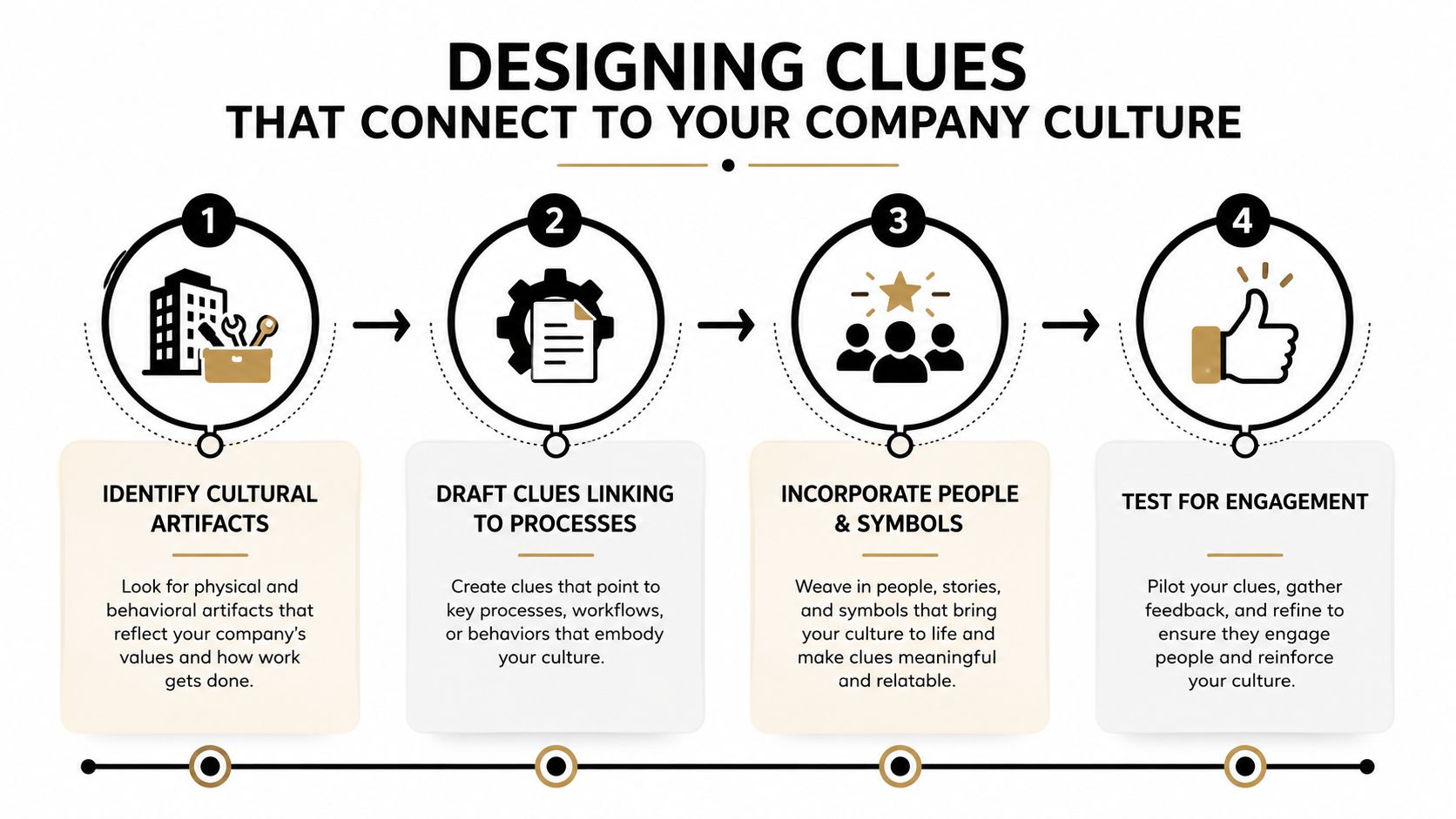
Culture-based clues should turn abstract values into observable work. Start with artifacts employees already encounter, such as product features, customer stories, internal tools, office symbols, team rituals, campaign assets, and decision records. Then define the action each artifact should prompt. Finding a poster creates little value. Explaining the behavior it represents, or linking it to a customer outcome, creates a learning moment that HR can evaluate.
Build from real processes
A useful clue sequence moves from recognition to interpretation, then application. Each stage should give participants something to discuss, submit, or use.
- Identify a cultural artifact. Choose something concrete, such as a product prototype, customer support principle, team dashboard, brand asset, or shared workspace.
- Connect it to a process. Ask who uses it, which decision it supports, or where it fits in the customer journey.
- Add people and meaning. Include a conversation with a process owner, a company milestone story, or a symbol that matters to employees.
- Test the experience. Confirm that the clue produces discussion and that someone unfamiliar with the route can understand the task.
The company culture game resource uses a similar culture-study approach. Increase difficulty through interpretation, not obscure facts. Early tasks can help participants locate a tool or colleague. Later tasks can ask them to connect that discovery to a value, customer promise, or dependency between teams.
Match clue types to the objective
For onboarding, direct a team to find the owner of an internal system and ask when new hires should use it. Require a concise explanation instead of a photograph. The task builds recognition and retrieval while creating a useful relationship.
For cross-functional connection, provide a customer scenario and ask teams to contact people from different departments to map the organization's response. A strong answer should require multiple perspectives, so one participant cannot complete the task alone. That design supports connection as an outcome rather than treating movement around the office as engagement.
For a milestone celebration, use company artifacts and stories instead of a timeline quiz. Teams might explain why a product decision mattered, match a brand asset to its campaign purpose, or ask long-serving employees about the context behind a tradition. The purpose is shared interpretation between newer and established employees, not a test of institutional memory.
A good clue creates a reason for people to ask better questions of one another.
Pilot every clue with someone unfamiliar with the route. Observe ambiguity, hidden assumptions, inaccessible locations, and tasks that reward speed over collaboration. Remove anything dependent on confidential information, personal disclosure, or insider knowledge. Record what each clue is meant to reveal, then review the responses after the event. If participants can finish without discussing the intended behavior or process, revise the clue before using the hunt to support onboarding, cross-functional connection, or culture goals.
Building Teams and Managing the Live Event
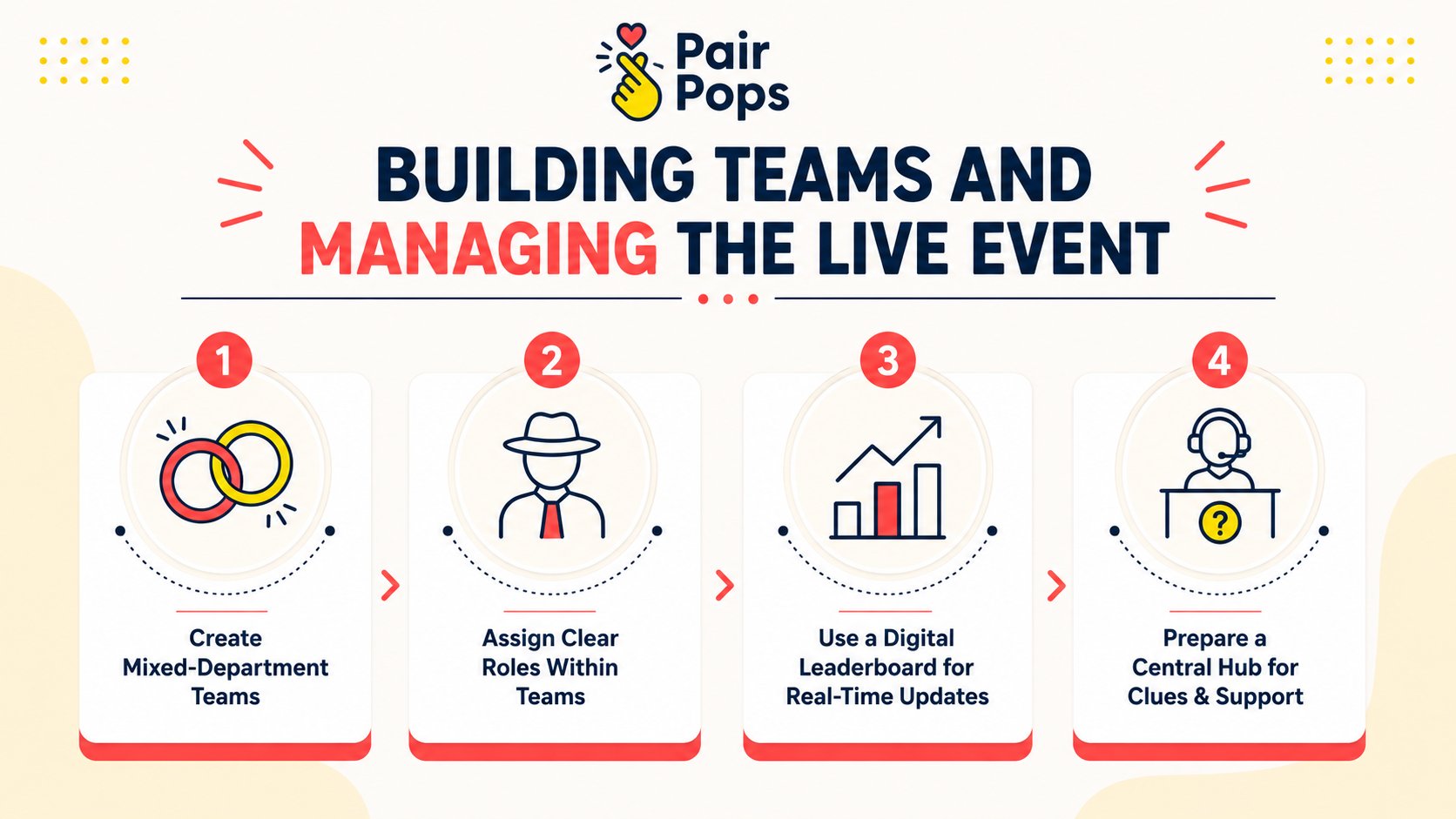
Team composition determines whether employees meet new colleagues or stay with people they already know. Pre-assign mixed-role groups across departments and seniority levels. Self-selected teams feel comfortable, but they often reproduce existing friendships and reporting lines. Mixed teams create more useful friction, provided the facilitator gives participants a reason to listen to one another.
Keep the scoring system easy to understand. Award points for completed tasks, thoughtful explanations, and evidence of collaboration. Avoid a formula so complicated that teams need a rules specialist. A simple scoreboard can create energy, while excessive scoring turns the event into administrative work.
Protect participation during play
Assign roles that rotate, such as navigator, clue reader, recorder, interviewer, and timekeeper. Give teams tasks that require contributions from more than one role. A facilitator should intervene when one person dominates, not by embarrassing that participant, but by directing the next clue to someone who hasn't spoken.
Common execution failures are operational rather than creative:
- Vague clues: Test wording with someone who doesn't know the route.
- Poor signposting: Provide a clear central help point and a defined escalation process.
- Unbalanced teams: Mix departments, seniority, communication styles, and relevant knowledge.
- Complex scoring: Use a visible rubric that teams can understand without repeated explanations.
- Accessibility gaps: Offer seated, indoor, digital, or remote alternatives for mobility and participation needs.
The central hub matters for more than logistics. It gives teams a place to resolve ambiguity, collect materials, and reconnect with the event purpose. For a large in-person event, facilitators can use a digital leaderboard for updates, but don't let the screen become the main experience. The relationships formed during the tasks matter more than constant rank changes.
A structured debrief should follow immediately. Ask what teams discovered, which assumptions changed, where collaboration broke down, and how the clues reflected the organization. Then connect those observations to work. A team that struggled to find a process owner may have exposed a real knowledge-management problem. A team that relied on one expert may have demonstrated why inclusive decision-making needs deliberate roles.
Adapting Your Hunt for Remote and Hybrid Teams
The format changes across locations, but the design test stays the same: every participant needs a meaningful role, every clue needs a clear purpose, and every team needs a shared moment to interpret what happened.
| Format | What changes | What stays essential |
|---|---|---|
| In-person | Physical route, rooms, objects, and live movement | Clear objectives, inclusive tasks, debrief |
| Hybrid | Parallel physical and digital paths, coordinated checkpoints | Comparable participation and shared scoring |
| Fully remote | App-based clues, video calls, photos, documents, and asynchronous tasks | Team interaction, cultural relevance, follow-up measurement |
A hybrid event fails when remote employees receive a passive livestream of an in-person hunt. Give distributed participants equivalent challenges. If an office team locates a product artifact, the remote team might analyze a digital version, interview its owner over video, or find the same story in an internal knowledge base. The tasks don't need to be identical, but they should demand comparable effort and produce comparable learning.
Use digital mechanics with restraint
QR codes, mobile apps, photo submissions, and short video checkpoints can make a remote or hybrid hunt easier to coordinate. The newer format described in corporate scavenger hunt activity guidance combines these tools with brief debriefs rather than relying only on printed clue lists.
For fully remote teams, assign a shared workspace for submissions and a video channel for live checkpoints. An asynchronous window can help employees in different time zones, but schedule at least one shared discussion if connection is a central objective. A photo challenge might ask each participant to show an object representing how they work, followed by a team discussion about the different approaches. That creates personal context without requiring employees to reveal private details.
Avoid making the hunt a technology test. Require only tools employees already understand, provide an accessible alternative to every image or movement task, and test the experience on different devices. Remote workers shouldn't lose points because a platform fails, a file format won't open, or a clue depends on being in a particular office.
The debrief deserves extra attention online. Use breakout rooms for team reflection, then bring everyone back to compare discoveries. Ask each group to name one new connection, one process they understand better, and one question that remains. Those responses provide useful qualitative evidence while helping the activity end with meaning rather than a leaderboard.
Measuring Results and Proving Business Value
Finishing every clue proves reach, not impact. Employees may complete the hunt without retaining onboarding information or building a relationship that helps them work across functions. Business value becomes visible when the activity has a defined baseline, an immediate follow-up, and a later check on knowledge or behavior.
Start with the objective set before launch. For onboarding, run a short knowledge check before and after the hunt, then revisit the same information during a later pulse. For cross-functional connection, ask whom participants met, what they learned about another function, and whether they know whom to contact with a relevant question. For culture, collect examples of how participants interpret the organization's values in real work situations.
Use a simple evaluation sequence
Measure participation and completion to understand reach and execution. Follow with satisfaction and open-text feedback to learn whether the experience felt useful, inclusive, and relevant. Then check retention or behavior change at the two-to-three-week mark. This timing is included in workplace guidance from team-building activity practitioners.
A practical sequence looks like this:
- Before the event: Capture confidence, familiarity, or connection levels related to the chosen objective.
- Immediately afterward: Repeat the core questions, add a knowledge check, and ask what participants can now explain or locate.
- Two to three weeks later: Check whether new hires retained key information, whether contacts were used, or whether participants can describe a culture behavior in context.
- During review: Compare responses by participant group, format, and objective rather than presenting one blended satisfaction score.
Observed behavior adds context to survey data. Facilitators can record whether teams shared roles, consulted multiple functions, and explained their reasoning. These observations are not scientific proof, but they can show whether the activity produced the collaboration it was designed to encourage.
Industry summaries sometimes cite directional benchmarks of up to $4–$7 in value per $1 spent and communication improvements of as much as 50%. The available guidance identifies these figures as secondary citations rather than primary research, so they should not be presented as guaranteed outcomes. Use your own baseline and follow-up evidence when making a leadership case.
The supplied business-metrics visual includes figures such as 45%, 85%, and 30%, but those values are not verified evidence for this article. Do not use them as organizational benchmarks without a defensible source and a clear measurement method.
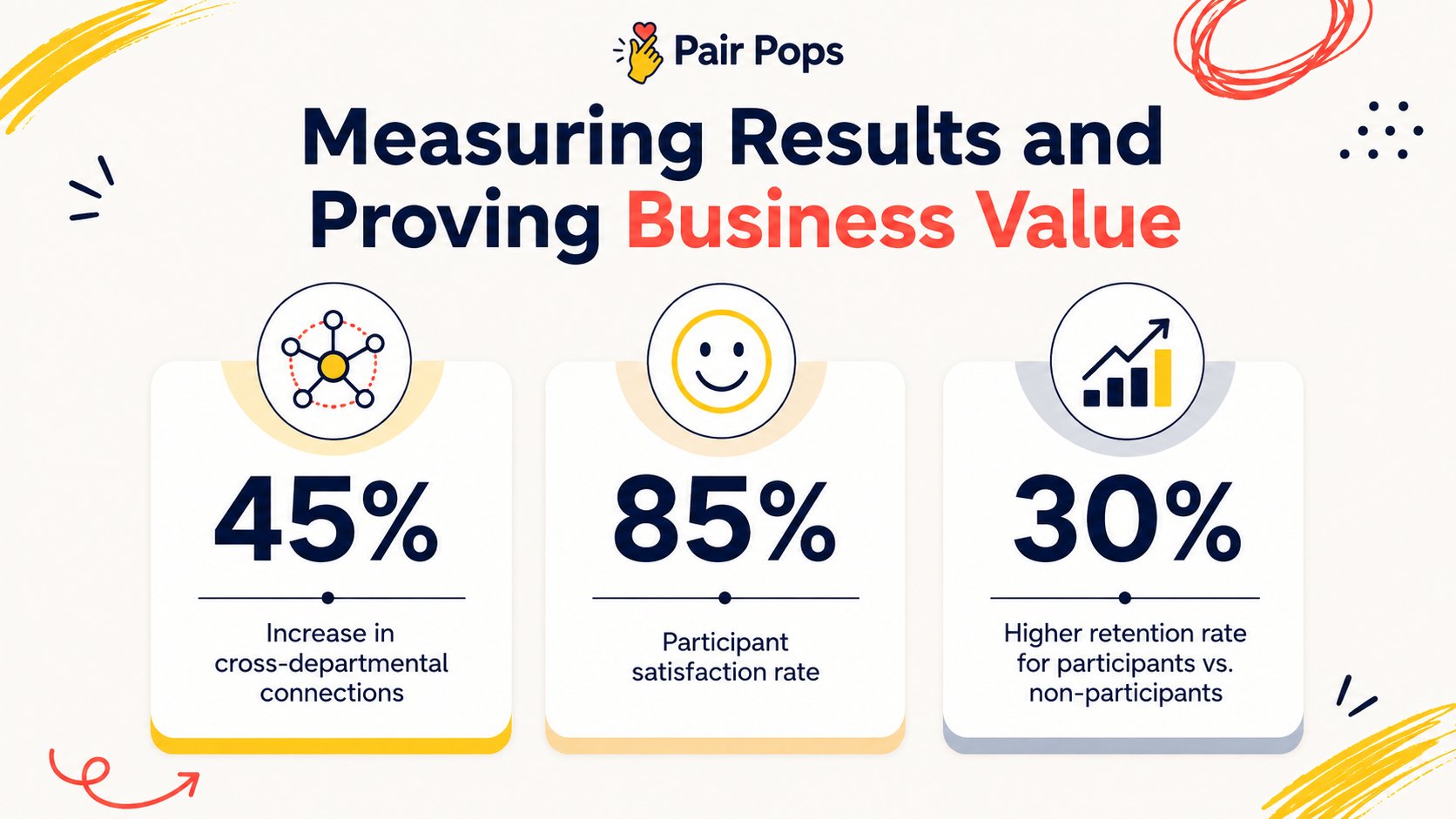
For a broader comparison of formats and evaluation considerations, review these team-building games with practical evaluation guidance. The strongest proposal to leadership will not promise a universal lift. It will show the objective, participant experience, evidence collected, limits of that evidence, and the decision the organization can make next.
If you want a memorable way to reinforce onboarding, culture, or cross-functional connection, explore PairPops for customized matching card games built around employees, products, branding, and visual assets. Request a free custom mockup to see how your company's people and culture could become an interactive team activity or branded giveaway.