
You have a new hire starting Monday. Their laptop is staged. Their access is provisioned. Their desk is ready. And you know from experience that the next 30 days will either cement their decision to stay or quietly plant the first seeds of doubt.
This checklist is built for HR managers and people ops leads at companies of 20–300 employees. It assumes you don't have a dedicated onboarding team. It's designed to be used tomorrow, not filed away.
But before the list: a framework that changes how the whole thing lands.
The Connection-Before-Compliance Rule
Most onboarding programs are sequenced around what the organization needs — paperwork signed, systems set up, policies acknowledged. That's not wrong. It's just in the wrong order.
The Connection-Before-Compliance Rule is simple: on day one, lead with a human moment before any administrative task. A real welcome from the manager. A structured team introduction. A game that gets names and faces into memory. Then, once that tone is set, handle the compliance.
The research backs this up. Gallup found that only 12% of employees strongly agree their organization does a great job onboarding them. The gap isn't usually in the paperwork — it's in the human experience of arriving somewhere new and not knowing anyone. A new hire who spends their first three hours filling out benefits forms is not a connected new hire. A new hire whose first hour involves a team introduction activity arrives at lunch already knowing people's names.
This rule applies to every phase below. Connection is always the lead. Compliance follows.
Before Day One: The Week Prior
The tone of onboarding is set before the new hire walks in the door. What they receive — or don't receive — in the week before day one signals whether their arrival was anticipated or incidental.
Pre-start checklist:
- Equipment delivered or staged at desk (laptop, monitor, keyboard, peripherals)
- All system access provisioned and tested — email, Slack, HR platform, role-specific tools
- Manager sends a personal message Thursday before the start date (video preferred over email)
- HR sends day-one logistics in writing: arrival time, where to go, who to find, parking/transit notes
- Welcome kit staged at desk or shipped (for remote hires, 5–7 business days early)
- Team introduction package ready — see the gap most programs miss below
- First week calendar pre-blocked with named activities, not just "orientation"
- Onboarding buddy identified and briefed on their role
The welcome kit gap: most companies ship branded items but nothing that helps the new hire learn who their teammates are. A team photo guide, an org chart with faces and names, or a personalized matching game sent before the start date addresses the thing new hires consistently say was missing: knowing who's who before they had to walk into a room full of strangers.
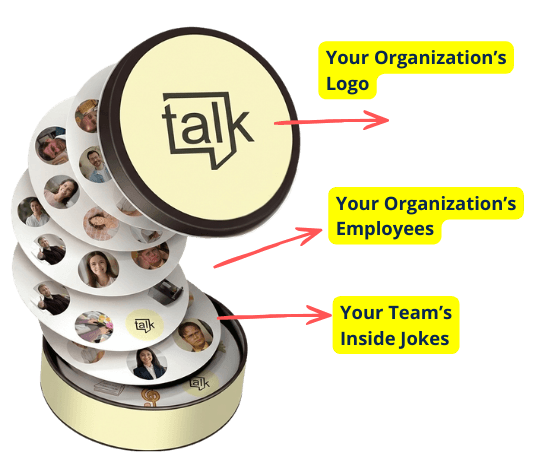
For teams that onboard 3+ people per month, a custom matching disc game built from your team's headshots is a reusable pre-boarding tool. Ship it with the welcome kit. A new hire who has played three rounds before their start date walks in already recognizing faces. The employee onboarding game is built specifically for this moment.
Day One: The First Six Hours Set the Register for Everything Else
Connection-before-compliance means reordering the day-one agenda. Here is a schedule that works:
- 9:00am — Manager welcome (30 min): personal, specific, not delegated to HR. Reference something from the hiring process.
- 9:30am — Team introduction activity (20 min): a structured format that encodes names and faces, not just a round of "say your name and one fun fact"
- 10:00am — Office or Zoom tour led by a team member (not facilities)
- 10:30am — IT setup and system walk-through (90 min)
- 12:00pm — Team lunch with the immediate team (6–10 people max, not an orientation group)
- 1:30pm — HR paperwork, benefits enrollment, compliance review
- 3:30pm — Manager meeting: 30-day expectations in writing, first assignment framed
- 4:30pm — End-of-day check-in: "How did today feel?" — a real question, not a rhetorical one
The order matters more than the items. A new hire who processes HR paperwork from 9am to noon arrives at lunch already feeling like a transaction. A new hire whose first interaction is a warm team introduction arrives at lunch knowing people's names and already in conversation.
High-Touch vs. Low-Touch Programs by Company Size
Not every company can run the same onboarding program. Here is what's realistic at different scales:
| Company Size | High-Touch (Recommended) | Low-Touch (Minimum Viable) |
|---|---|---|
| 20–50 employees | Manager runs day one personally; founder meets new hire week one; buddy is a senior peer | Manager available day one; buddy assigned; 30-day retro scheduled |
| 50–150 employees | Cohort onboarding 2x/month; structured intro activity; cross-functional coffee chats pre-scheduled | HR-run orientation day; manager check-ins 2x/week; 30-day pulse survey |
| 150–500 employees | Dedicated onboarding coordinator; cohort events; 90-day buddy program; tracked metrics | Standardized orientation deck; manager guide distributed; 90-day retention tracked |
The minimum viable column is what you fall back to when capacity is stretched — not the goal. The goal is high-touch, with automation and tools (games, templates, pre-scheduled calendars) doing the work that staff can't do manually.
Week One: Structure Over Spontaneity
Week one is when new hires decide whether they made the right choice. The companies that lose people at 30 days are almost always the ones that over-rely on "they'll figure it out" after day one.
Week-one checklist:
- Daily 15-minute manager check-in (real conversation, not a status update)
- Pre-scheduled 1:1 coffee or chat with 4–5 team members (HR books these — don't leave it to the new hire to initiate)
- Role clarity document delivered and reviewed: what success looks like at 30 days, specifically
- First assignment: completable within week one, clear outcome, doesn't require institutional knowledge they don't yet have
- Introduction to 2–3 cross-functional partners they'll regularly work with
- Onboarding buddy checking in daily (peer-level, not manager)
Weeks Two and Three: The Integration Gap Most Programs Miss
This is where most onboarding programs collapse. Day one had structure. Week one had check-ins. Weeks two and three get nothing — and the new hire, who is no longer running on the adrenaline of novelty, is now alone with whatever doubts have formed.
- Transition from daily check-ins to 3x/week — but don't drop them entirely
- First formal feedback conversation with manager: "Here's what I'm observing. Here's what I need from you right now."
- Shadow at least one cross-departmental meeting relevant to their role
- Second assignment with a clear deliverable and deadline within this two-week window
- Informal team moment if the week-one introduction activity didn't happen in person
Day 30: The Retrospective That Closes the Loop
The 30-day retrospective is the most underused tool in onboarding. It is not a performance review. It's three questions: What has gone well? What has been confusing or missing? What do you wish you'd known on day one?
Run it separately from the manager if you want honest answers about the manager. Document the outputs. Use them to update this checklist every quarter. The pattern in the first 10 retrospectives will tell you exactly what your onboarding program is missing.
The Onboarding Decision Tree
If you're auditing an existing program, start here:
Does your onboarding include a structured team introduction activity on day one? If no — that's your highest-leverage gap. Everything else is secondary. If yes — does the new hire know 5+ team members' names and faces after week one? If no — the introduction activity isn't working; replace it with something that encodes names through active engagement (a game, a structured round-robin, anything with repetition). If yes — move to: does the new hire have a written 30-day expectations document? If no — that's the next gap. Unclear expectations are the second most common driver of 90-day departure. If yes — is a 30-day retrospective scheduled? If no — you have a program that may be working but can't improve because you have no feedback loop. If yes — your program has the core structure; now optimize the quality of each element.
What Most Checklists Miss
After reviewing onboarding programs at dozens of companies of 20–300 employees, five gaps appear consistently:
- No structured team introduction — new hires are told to "meet people as they go," which means they don't
- No pre-boarding — orientation starts on day one, not the week before, so the new hire arrives cold
- Manager absence on day one — the new hire is handed off to HR, and the manager appears briefly on day two
- No 30-day retrospective — onboarding just stops, with no feedback loop and no signal that the experience mattered
- Remote new hires run through an identical program to in-person hires — which means they get a fraction of the social context
The fix for the team introduction gap is the highest-ROI single change. The employee onboarding game page covers one specific, low-effort way to do it. For what happens when these gaps aren't fixed, see the onboarding mistakes article.
When This Checklist Is Not Enough
A 30-day checklist isn't a complete onboarding program. It's the first third. If your company has high-complexity roles (legal, engineering, clinical), if new hires work across multiple time zones, or if you're running cohort onboarding for 20+ people at a time, this checklist is a starting point — not a finish line. SHRM recommends onboarding programs of at least 90 days; talent management research suggests one year for full integration in senior roles. Use this checklist for the foundation and build from there.
Practical Scenario: How Ridgeline Partners Used This Framework
Hypothetical example, for illustration only — Ridgeline Partners is not an actual PairPops customer, and these figures are not measured results.
Ridgeline Partners is a 90-person professional services firm that onboards 8–12 consultants per quarter. Their previous onboarding was a one-day orientation followed by unstructured shadowing. 90-day retention was 74%. After implementing Connection-Before-Compliance — leading day one with a team introduction activity (a matching game with headshots of the existing team), adding daily manager check-ins in week one, and scheduling a 30-day retrospective — their 90-day retention reached 89% within two cohort cycles. The change that mattered most, according to their People Ops lead: pre-boarding. New consultants who received the game before their start date reported feeling "like I already knew the room" in the week-one pulse survey.
Frequently Asked Questions
How long should employee onboarding last?
Research consistently points to 90 days as the minimum effective onboarding window. SHRM data shows that employees who complete a structured onboarding program are 58% more likely to still be with the company after three years. Companies that treat onboarding as a single-day orientation event see significantly higher 90-day turnover. For senior or complex roles, one-year onboarding programs are increasingly standard among high-performing companies.
What should happen before an employee's first day?
Equipment, system access, a personal manager message, and day-one logistics at minimum. High-performing programs also send a welcome kit with something that helps the new hire learn who their teammates are — a team photo guide, an org chart with faces, or a personalized game. A new hire who arrives knowing team members' names by sight feels less like a stranger from hour one.
What is the most important thing on an onboarding checklist?
A structured team introduction activity on day one. Gallup research shows that only 12% of employees strongly agree their company does a great job onboarding them. The gap is almost always social: new hires don't know their teammates' names by the end of week one. That social gap is the single strongest predictor of departure in the first 90 days.
What is the "connection-before-compliance" rule?
Connection-before-compliance means leading day one with a human moment — a team introduction, a genuine manager welcome — before any HR paperwork or IT setup. The compliance tasks still happen; they just happen in the afternoon, after the tone has been set. The order sends a signal about what the company values. When compliance comes first, the message is bureaucratic. When connection comes first, the message is: you belong here.
How do you measure whether onboarding is working?
Track three metrics at day 30, 60, and 90: retention rate, new hire engagement score (specifically the "I feel connected to my team" question in a pulse survey), and time-to-productivity via manager assessment. The 30-day team connection score is the most actionable early signal — a score below 3.5 out of 5 is a warning that departure risk is elevated, while you still have time to intervene.