
You've spent three weeks preparing for this new hire. The laptop is staged. The welcome kit is on the desk. The team lunch is booked for noon. And you know, from the new hires who left in the first month, that today will either cement their decision to stay or quietly plant the first seed of doubt.
Most first days don't fail dramatically. They fail quietly — through a sequence of well-intentioned logistics that leave the new hire feeling like a transaction by 3pm. The research on first-day experience is clear: belonging forms early, and it forms through specific moments of social recognition, not through information transfer. A new hire who processes 90 minutes of benefits enrollment before meeting a single person on their team receives a clear message — even if it's unintentional — about what kind of place this is.
Before the template: the one rule that changes how every element of the day lands.
The Social-Before-Admin Rule
The Social-Before-Admin Rule is simple: on the first day, every social moment comes before every administrative task. The team introduction activity happens before IT setup. The manager's welcome happens before HR paperwork. The team lunch happens before benefits enrollment.
SHRM research shows that 89% of new hires expect to meet their manager on day one, and 83% expect to be introduced to their colleagues. When these expectations aren't met — when day one opens with a packet of forms and a waiting room — the message absorbed is not neutral. It's bureaucratic. And that tone, once established, is hard to shift before the end of the day.
The logistics still have to happen. They just happen in the afternoon, after the social tone has been set. Paperwork signed at 2pm doesn't feel different than paperwork signed at 9am — except that at 2pm, the new hire knows three people's names and has already laughed at something.
The Hour-by-Hour Template (In-Person)
For remote equivalents, see the remote onboarding guide.
8:45am — Early arrival welcome. The manager or a designated team member is waiting — not checking their phone, not finishing an email. Waiting. This is a small act with a large signal: you were expected. You matter today. Don't delegate this to reception or to HR.
9:00am — Manager welcome (30 min). This conversation is not about the role. It's about the person. The manager's job is to communicate genuine, specific excitement: "I've been thinking about what you said in your interview about how you approach X." Reference something real from the process. This is not a performance — it's a demonstration that the manager paid attention. If the manager spent six hours interviewing this person and can't recall one specific thing about them, that's a manager problem to solve before day one.
9:30am — Team introduction activity (20 min). This is the item most first-day programs either skip or execute badly (a round of "say your name and one fun fact" in a circle doesn't count). What works is an activity that encodes names and faces through active engagement rather than passive listening — something with rules, a clear endpoint, and a mechanic that creates the repetition needed for memory formation.
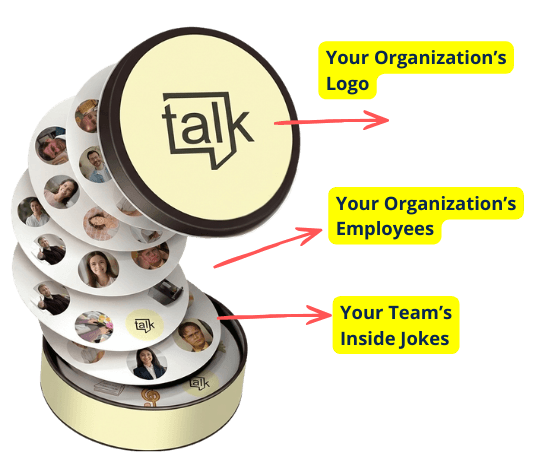
A personalized matching disc game built from your team's headshots is the format most consistently effective here. The mechanic — racing to find the shared face between two discs — runs on its own, creates competition and laughter, and forces the new hire to actively process faces rather than passively hear names. A new hire who has played three rounds of the employee onboarding game knows more names at 9:50am than someone who sat through a 20-person round of introductions. No one has to perform. No one has to be funny. The game creates the connection.
9:50am — Office tour (30 min). Led by a team member, not facilities. The tour is an informal continuation of the introductions — two people, walking around, talking. It's where the first real one-on-one conversation usually happens.
10:20am — IT and systems setup (90 min). The necessary slog. Email, Slack, all role-specific tools. After the social tone is established, this is fine — it's expected, it's practical, and the new hire has context for why they need these specific tools because they've already met the people they'll be using them with.
12:00pm — Team lunch. The immediate team: 6–10 people maximum. With a soft agenda: each person shares one thing about themselves that isn't on their LinkedIn. This replaces the formal round of introductions while still creating the personal disclosure that makes colleagues feel like people rather than org-chart nodes. Don't invite the whole floor. Don't turn this into a company showcase. Keep it to the team the new hire will actually work with.
1:30pm — HR and benefits walkthrough (60 min). Paperwork, benefits enrollment, policy acknowledgments. This is the right slot for compliance — the afternoon, after the social and human experience of the day has been established. The new hire processes this with context rather than as their first introduction to the company.
2:30pm — Role overview with manager (30 min). Not the full 90-day plan. Just the next two weeks: what the new hire will be doing, who they'll be working with, and what success looks like at the end of month one. In writing. Not a slide deck — a one-page document they can read on the way home. The absence of written 30-day expectations is one of the most consistent patterns in exit interviews from people who left before 90 days.
3:00pm — First assignment (60–90 min). One task, completable today or tomorrow, with a clear deliverable. Not "read the documentation." Something that produces something: "Review these three things and send me your initial impressions." Contribution creates belonging faster than observation. A new hire who ends day one having produced something feels different about this job than one who ends day one having consumed information.
4:30pm — End-of-day check-in with manager (15 min). One question: "How did today feel?" Then actual listening — not reassurance, not performance, not a summary of what's coming tomorrow. Genuine curiosity about what the new hire experienced. This conversation catches problems before they become patterns. Without it, the new hire goes home without knowing if anyone noticed their presence or whether they did the right things.
Traditional vs. Connection-First Day One
| Element | Traditional Sequence | Connection-First Sequence |
|---|---|---|
| 9:00am | HR paperwork and compliance | Manager personal welcome |
| 9:30am | Benefits enrollment | Team introduction activity (game) |
| 10:00am | IT setup | Office tour with team member |
| 11:00am | Orientation presentation | IT setup and system walkthrough |
| 12:00pm | Lunch (often alone or with HR) | Team lunch with immediate team (6–10) |
| 1:30pm | Department meetings | HR and benefits walkthrough |
| 3:00pm | Role overview from manager | 30-day expectations doc + first assignment |
| 4:30pm | No formal close | End-of-day check-in: "How did today feel?" |
| New hire leaves knowing | Benefits, policies, IT login | 5+ colleagues by name, 30-day expectations |
The 3 Things That Make the Day Work (That Aren't on the Schedule)
The template is a skeleton. Three things determine whether it works:
First: the manager's morning conversation is personal, not logistical. "Here's your laptop password and your Slack channels" is not a welcome. "I've been looking forward to this — let me tell you why" is. The emotional register of this conversation sets the tone for everything that follows. If the manager treats it as orientation, the day feels like orientation. If the manager treats it as a moment that matters, it is a moment that matters.
Second: the team introduction activity actually encodes names. "Everyone say your name and something interesting" does not. The difference is active engagement versus passive listening. A game, a structured rotation, a format that requires the new hire to do something with each person's face and name — not just hear it once and forget it by lunch.
Third: the end-of-day check-in is a real question, not a rhetorical one. "How did today feel?" followed by "Great, see you tomorrow" is not a check-in. "How did today feel?" followed by listening and a follow-up question is. The new hire who ends day one with someone specifically asking how they experienced the day has a qualitatively different first day than the one who walks out without that conversation.
What Day One Can't Fix
Day one is not a substitute for the rest of onboarding. A great first day followed by two weeks of unstructured drift will not retain a new hire who needed continued support. Day one sets the tone; the first 30 days deliver on the promise that tone makes. If you're investing in a strong day one but not running daily manager check-ins in week one and a 30-day retrospective conversation, you're building a foundation without a structure on top of it.
Also: day one can't compensate for a role that was misrepresented in the interview process, a manager relationship that is fundamentally mismatched, or a team that doesn't have time to integrate a new person. If those are the real problems, the hour-by-hour schedule won't solve them. Use exit interview data to separate "day one disappointed them" from "the role disappointed them" — they require different solutions.
Practical Scenario: How Aldgate Creative Fixed a 40% 30-Day Departure Rate
Hypothetical example, for illustration only — Aldgate Creative is not an actual PairPops customer, and these figures are not measured results.
Aldgate Creative is a 60-person design studio in Chicago that was losing 40% of new hires before day 30. Their previous first day: HR met the new hire at 9am, ran a two-hour orientation, and handed them off to their manager at noon. The manager had a client call at noon. By 2pm, the new hire was at their desk alone with no assignment and no idea who to ask for one. Exit interviews were consistent: "I felt like I was bothering people just by being there."
Their fix: they restructured day one using Connection-Before-Admin. A senior designer (not HR) greeted every new hire at 8:45am. The first 20 minutes were a team card game built from headshots of the existing team. The manager handled lunch personally. HR paperwork moved to 2:30pm. 30-day departure rate dropped from 40% to 11% in two cohort cycles, with the morning connection activity identified as the most likely driver of the change.
Frequently Asked Questions
What do new employees want on their first day?
Three things consistently: role clarity (to know what they're supposed to be doing), recognition (to feel like someone expected and prepared for their arrival specifically), and social belonging (to make at least one genuine human connection). SHRM data shows 89% of new hires want to meet their manager on day one and 83% expect colleague introductions. The belonging need is the hardest to engineer and the most commonly missed — most programs deliver logistics competently and miss connection almost entirely.
What is the most common first-day mistake companies make?
Leading with compliance instead of connection. When the first two to three hours involve HR forms and IT setup with no real human interaction, the message received is bureaucratic rather than personal. The fix: lead with a genuine team introduction and reserve admin for the afternoon, after the social tone has been established.
How long should a new hire's first-day schedule be?
A full workday, but every block must be named. Unstructured downtime is the most common cause of first-day anxiety — a new hire who doesn't know what to do or who to talk to fills that time with doubt. A virtual lunch, a self-guided exploration window, and a first assignment all count as structure. What matters is that no period is blank.
Should a new hire's first day include work assignments?
One small, completable task is ideal. Scope: 30–60 minutes, clear outcome, doesn't require asking more than one person for context. Something that produces a deliverable, not something that requires reading documentation. Larger assignments belong in week two when the new hire has enough context to approach them without anxiety.
What should the manager do on the new hire's first day?
Be personally present at the open and close. Greet the new hire before anyone else does. Have a morning conversation that is personal and specific — reference something real from the hiring process. Join the team lunch or activity if possible. Close the day with "How did today feel?" — and actually listen to the answer. The entire day doesn't need the manager present, but the first and last conversations should belong to the manager, not HR.